Queer Joy Lives On Inside a Car Door
The artist understands his lifelong relationship with SAAB cars as a gay man’s search for safety and community
The exhibition By Your Side (The Parsonage Gallery, Searsport, Maine, March 7 – May 3, 2026) is artist Dan Dowd’s commemoration of his lifelong devotion to Swedish-made SAAB automobiles, which he has driven exclusively since 1991. SAAB ceased automobile production in 2011, meaning Dowd is now likely driving his last SAAB. But Dowd does not intend By Your Side to be elegiac. It’s more like a “celebration of life” than a memorial service.
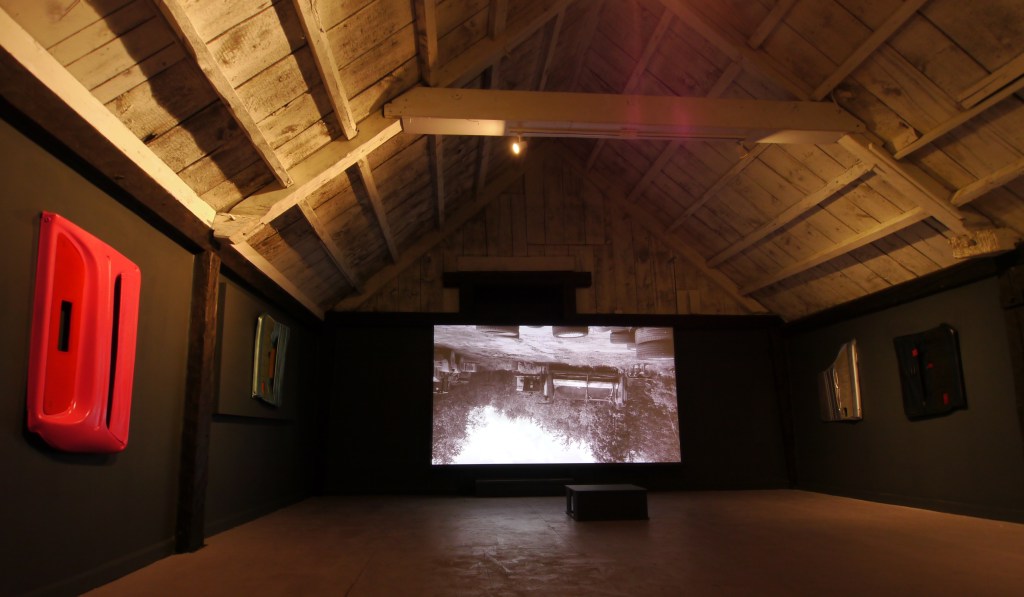
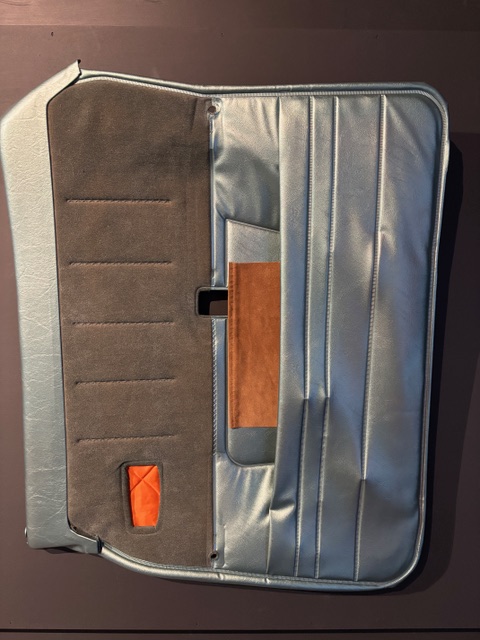
Seven wall-mounted panels reveal themselves as the interiors of car doors through telling details, such as shallow pockets and curved wheel wells, though Dowd has turned each one sideways or upside down. There are the expected colors of black and silver, but also metallic turquoise, royal blue, and the pinkest-of-pinks. Dowd chose each color in reference to specific SAAB exterior options. The titles (e.g. 1980923MSR) are model numbers—nonsense to the uninitiated, but this sense of insider knowledge is intentional.
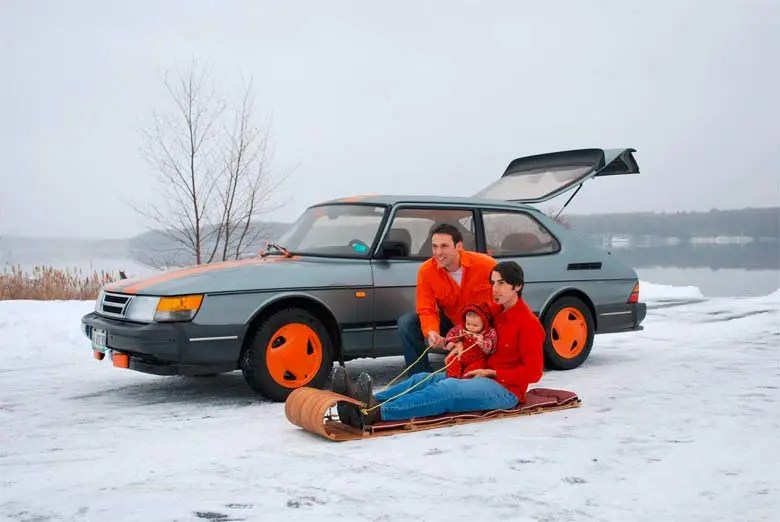
Dowd associates SAAB’s reputation for a distinctive look, and its identity as a brand with a devoted following of “SAAB people,” with his own identity as a gay man: being aesthetically set apart from the crowd; finding “your people.” The title By Your Side references the safety and security of the car’s interior— a safe space to be yourself, whether alone, with a partner, or with a friend. But safety, for a gay man who came of age in the 1980s, is not just a feeling or a buzz word.
In 2011, Dowd was deferred from giving blood because he is a gay man, a discriminatory policy that is a long-outmoded relic of the AIDS crisis. In response, Dowd produced Projekt 900 in 2012, altering a vintage SAAB brochure with photographs of heterosexual men posing as gay couples and families. Projekt 900 used the visual tropes of marketing to make wholesome what had been made taboo by bigotry and the homophobic AIDS panic.
In By Your Side, Dowd takes a more autobiographical approach to this idea of the car as a locus of queer safety. Subtle fabric interventions on the panels emerge—pops of red felt, quilted Hunter orange, and rectangles of brown suede. Dowd has recently been producing assemblages from found fabrics, some of which serve as portraits of the person who wore the original materials. The clothes we wear absorb our sweat and our skin. Like our cars, they are by our side; they are inanimate and yet form an intimate part of our identity. Friends of Dowd’s might recognize the fabrics in By Your Side from specific articles of clothing he has worn for years. Thus like a Renaissance painter, Dowd has inserted his self-portrait into these panels.
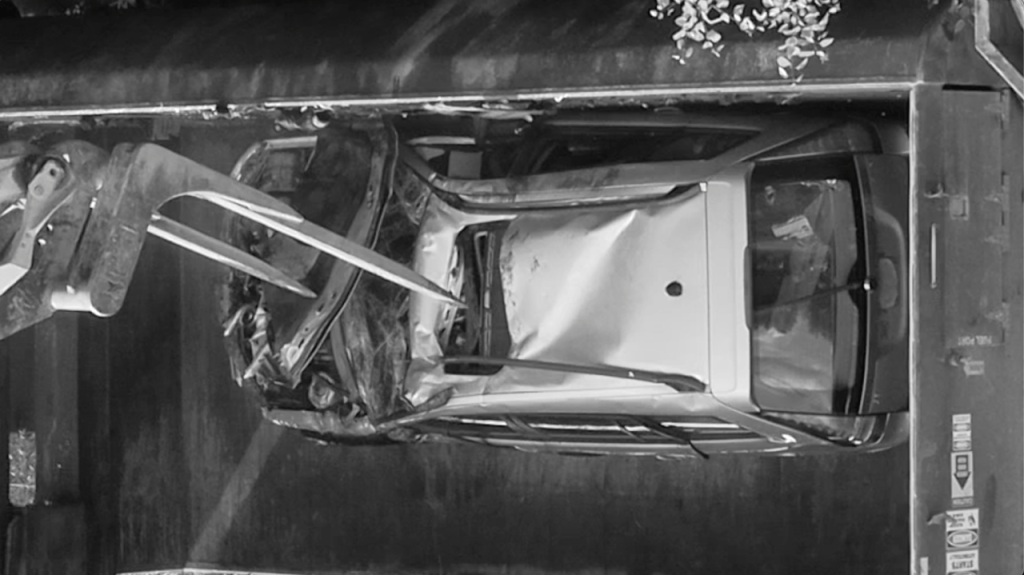
Anchoring the exhibition is video footage of a car being crushed, but run in reverse, upside down, and in black-and-white. As the video runs, the crushed car reinflates itself; dangling parts reattach. It has the feeling of a surrealist’s nature documentary. A forklift’s prongs take on the prodding motions of a praying mantis, while the car on its back reminds one of a flailing beetle.
Dowd’s exhibition is on view on the second floor of The Parsonage Gallery in Searsport, Maine. Accessed by a modern spiral staircase, the attic-like space has a vaulted ceiling in a rustic white. The space is hushed; only the hum of the projector provides a soundtrack. The gallery combines antique and modern, religious and secular, in a way that is appropriate to its origins and function: a contemporary art gallery in a historic house; a one-time home for a local nineteenth-century reverend, who happened to marry the aunt of renowned artist and pride of Maine, Winslow Homer. Adding to the sense of the sacred, the gallery’s founder and director Dr. Aaron Rosen is a religion scholar who suffuses his gallery text with a religious interpretation of Dowd’s work, comparing the panels to relics and altarpieces.
Seen through this lens, the video reconstruction of the discarded vehicle is a resurrection: an ending that is also a beginning. Thus Dowd has hope that his beloved SAAB community will still be a part of his life. As he said to me, “The miles keep piling on even though the wheels stop spinning.”


Leave a comment